
Healing in Crisis: Women, Global Health, and Human Security
By: Jasmine Hernandez & Marcela Ventura
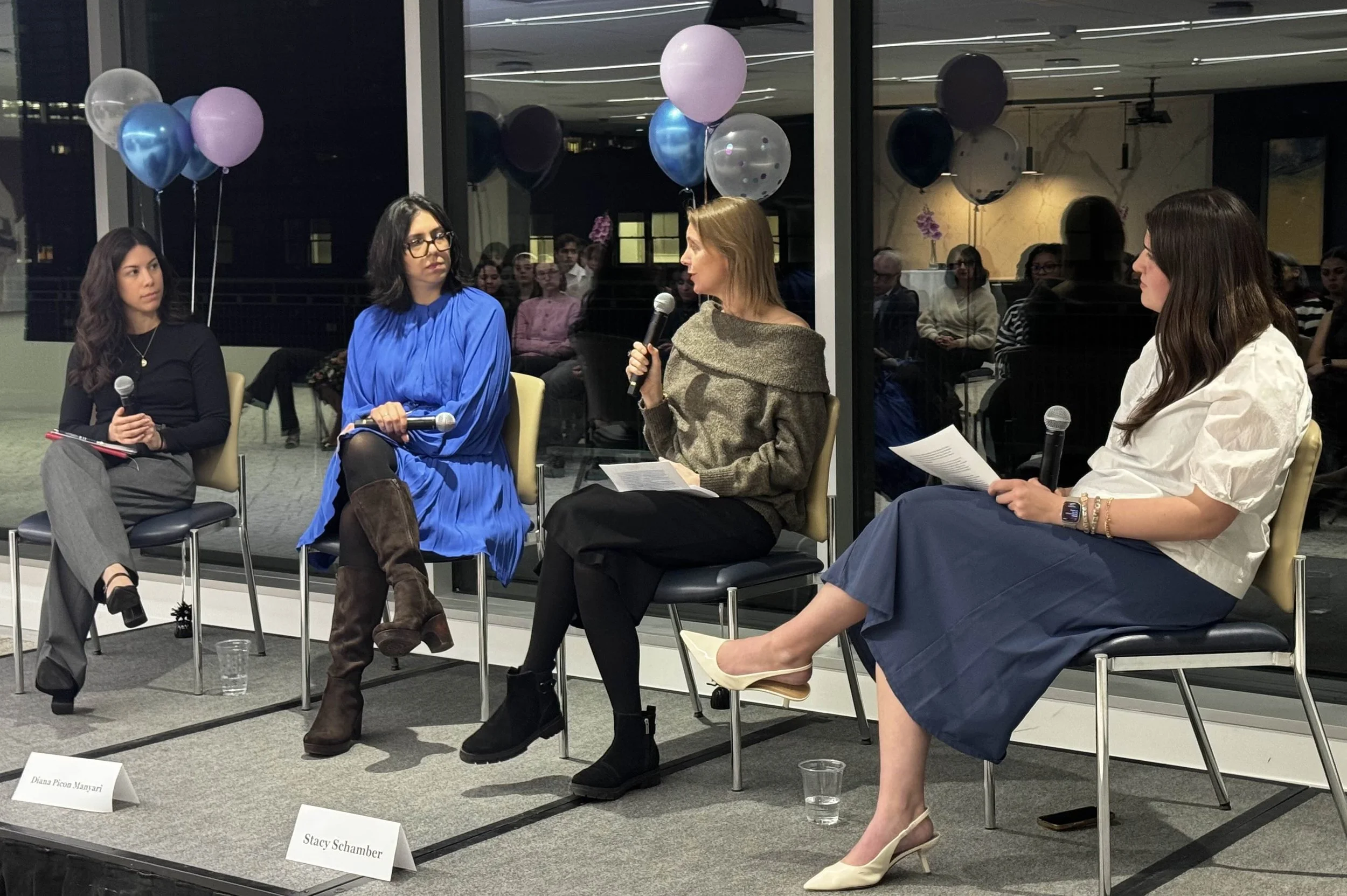
Kallie Mitchell (Far Left), Diana Picon Manyari (Middle Left), Stacy Schamber (Middle Right), Ava Van Norwick (Far Right)
On March 1, 2026, the George Washington University Student Consortium on Women, Peace, and Security commemorated International Women’s Day with a panel discussion titled “Healing in Crisis: Women, Global Health, and Human Security.” The event focused on how conflict and violence affect women’s health globally, bringing together practitioners and policy experts working at the intersection of gender, humanitarianism, and global health.
The discussion examined the consequences of crisis environments on women’s lives, including trauma, malnutrition, infectious disease, limited access to and healthcare, as well as the implications on human security. Panelists also reflected on the relationships among humanitarian response, feminism, and sustainable peacebuilding, emphasizing the structural and long-term dimensions of health insecurity in conflict-affected regions.
The panel featured Kallie Mitchell, Program Head and Analyst for the Gender Policy Portfolio at the New Lines Institute; Diana Picon Manyari, a global health and development practitioner with over 20 years of experience working across Africa, Latin America, and Southeast Asia; and Stacey Schamber, Senior Program Officer at the International Civil Society Action Network (ICAN) specializing in protection and psychosocial support in conflict settings. Drawing from backgrounds in gender policy, public health programming, trauma care, and humanitarian response, the panelists brought both policy and field-based perspectives to the discussion. The conversation was moderated by Ava Van-Norwick.
Reproductive and Sexual Health: What Gendered Health Issues Are Addressed — and Overlooked — and Why Is Trauma Underfunded?
The panel began by moving beyond reproductive and sexual health to examine gendered health issues that often receive less attention in policy and funding conversations.
Picon Manyari explained that within monitoring and evaluation frameworks, trauma is difficult to measure and communicate. She mentioned how challenging it is to tell women’s trauma stories through a single statistic. Because funding and legislation often rely on quantifiable indicators, trauma can be difficult to advocate for in policy spaces. Its complexity makes it hard to translate lived experience into data that can secure sustained support.
Mitchell continued this point by discussing the challenge of trying to tell stories through numbers. She emphasized that asking women to speak about gender-based violence requires them to take significant risks, especially in environments where coming forward can lead to becoming targets. Beyond individual risk, she identified a structural issue: trauma and gender-based violence are frequently brushed aside because they are uncomfortable and politically difficult topics to confront.
Schamber reframed violence against women as a public health issue. She cited the statistic that one in three women globally will experience sexual or physical violence in their lifetime, revealing how widespread the crisis remains. Despite this prevalence, funding and policy responses often do not reflect its scale. She argued that institutions must create the space and courage necessary to address the complexity of violence and trauma rather than treating it solely as a political issue.
International Norms Protecting Medical Workers: How Are They Violated — and What Does This Mean for Women and Girls?
The panel also addressed the weakening of international norms that prevent harm against medical personnel in conflict. Mitchell connected this erosion to the current political climate, describing a rise in militarized and masculinized political action in which calls for restraint and peace are dismissed and protection norms become harder to defend. Schamber highlighted the scale of violations, stating that from October 7 to last June over 917 healthcare workers were killed and more than 1,400 injured in Gaza, and that Ukraine has recorded more than 2,881 attacks on healthcare workers. These attacks disproportionately affect women and girls, especially for pregnant women and caregivers who depend on functioning health systems. Picon Manyari described this moment as a crumbling of security, emphasizing how devastating it is to see healthcare workers deliberately targeted, and stressing that even in crisis, protections for those helping others must remain intact. Healthcare workers are not only physically risking their lives, but also risking their emotional and mental wellbeing.
Climate Change, Disease, and Gendered Vulnerability in Human Security
In discussing climate change, the panel highlighted how environmental stress compounds existing vulnerabilities for women and girls. Schamber pointed to Yemen as an example, where prolonged war and water scarcity have contributed to the spread of disease. This demonstrates how climate pressures intersect with conflict and require both humanitarian response and peacebuilding efforts. Picon Manyari emphasized the rise of infectious diseases such as malaria in regions where they were not previously prevalent, noting that women are often the primary caregivers for those who fall ill. This caregiving burden increases exposure and risk, while also placing women and girls in situations of violence. She also stressed the importance of energy access and the persistent lack of gender-disaggregated data, explaining that without representative, localized studies, it is difficult to fully capture how climate change affects women and girls differently and to design effective responses.
State and Organizational Responses: What Is Being Done to Support Women and Girls?
In addressing how states and organizations are responding, Schamber opened the discussion by explaining a troubling pattern of funding cuts and institutional paralysis, pointing specifically to the defunding and shutdown of USAID and the overall lack of coordinated state-level response. Despite these shutdowns, she raised a critical point of how significant work continues on the ground, specifically through women-led organizations that approach crises holistically through women, peace, and security frameworks and development efforts. However, she observed that international organizations have struggled to work collaboratively across sectors. While there are efforts to convene actors from philanthropy and other sectors to increase support from the top, much of the important action remains localized, driven by women leaders responding directly to community needs.
What Interventions Work? Feminism, Policy, and Community-Based Healing
Van Norwick then moved the conversation to the final question of what interventions actually work. Picon Manyari began with highlighting funding reductions in gender and climate programming, but also pointed to continued efforts by academic institutions, NGOs, and local actors. She referenced a UN Women article projecting that climate change could push 60 million women and girls into poverty by 2050, highlighting the urgency of sustainable intervention. However, she stressed that representation alone is not enough. The women and girls most affected must be directly involved in decision-making processes, rather than positioned as token voices.
Mitchell pointed out the importance of gender-responsive policy that anticipates crises rather than reacting after harm has occurred, highlighting that institutions already possess the historical data and evidence demonstrating predictable patterns of crisis. The issue, she suggested, is not a lack of knowledge but a failure to institutionalize preventative systems before emergencies arise. The panel also reflected on feminist approaches that center the body and community in healing. Mitchell shared an example from work with survivors in Bosnia, where a massage experience helped women regain autonomy over their bodies by allowing care only where and how they consented. The discussion highlighted how trauma resides in the body and pointed to the role of security frameworks, access to care, green space, and feminist networks in helping women peacebuilders support one another and build resilience.
Promoting Healing in Crisis
The discussion concluded with reflections on how healing can be promoted during times of crisis. Schamber described the importance of shifting away from systems built on control, reminding the audience that responses should center on care: “it’s not based on control, it’s based on care.” Turning to the audience, Picon Manyari spoke about the role of community, saying “these are your people,” and encouraged continued efforts to build and sustain these networks of support. Mitchell closed the discussion by stating the need for more direct and honest conversations about these challenges, stressing the importance of being frank about the issues in order to begin addressing them.
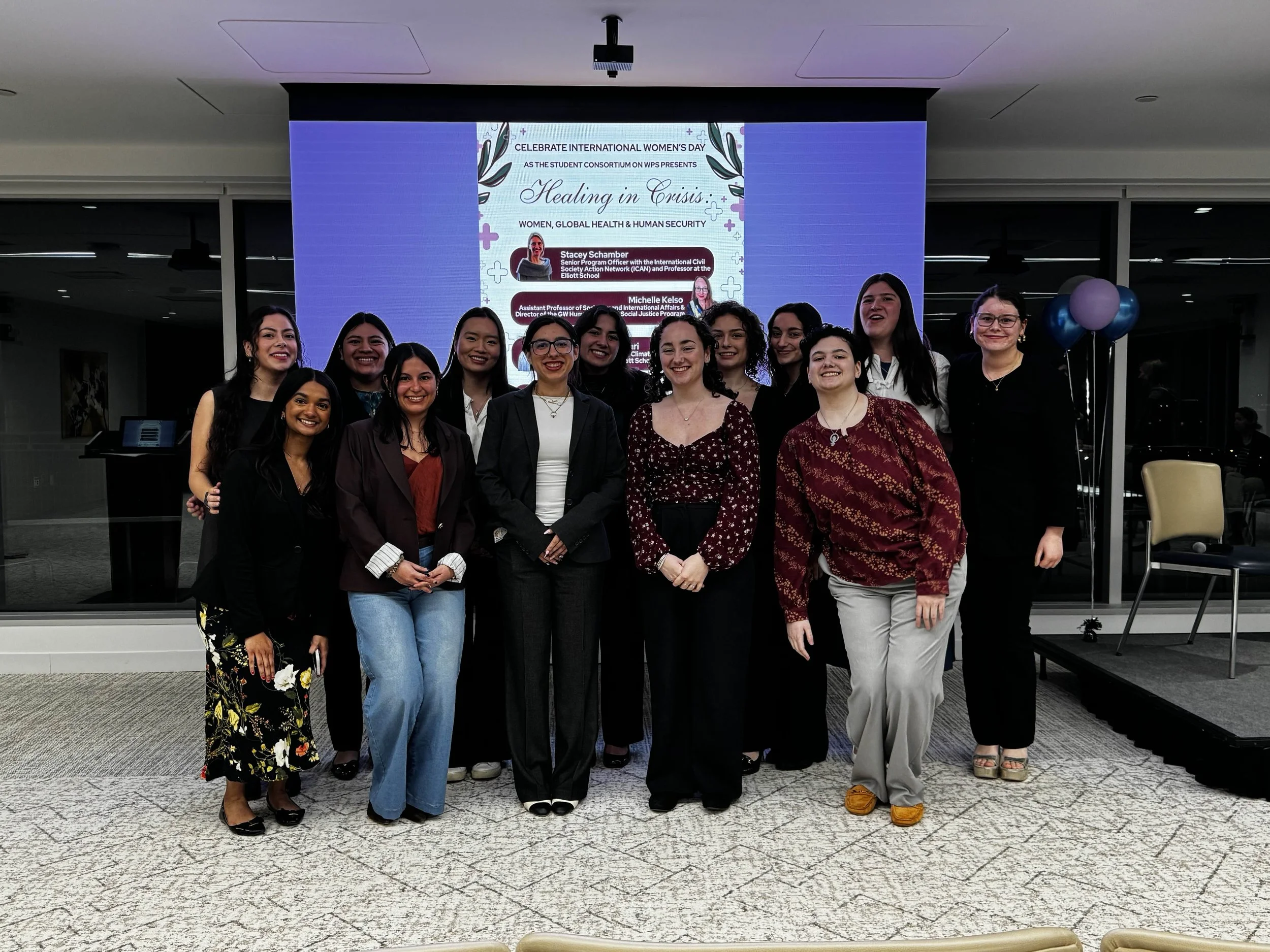
The George Washington Univeristy Student Consortium on Women, Peace, and Security
Featuring e-board members of the consortium
Q&A Discussion
After the discussion, the floor was opened to attendees to ask the panelists any questions they might have. This portion of the event touched on topics such as the future of UN Women, the role of technology, and the future of the WPS agenda. Relevant topics to today’s changing environment and major budget cuts.
When asked about the possible merger of UN Women with the United Nations Population Fund (UNFPA), panelists had different opinions but agreed on the importance and relevance of both organizations. While Picon Manyari noted that the merger was inevitable and only hoped for the goal of each organization to remain relevant, Mitchell saw it as a “depreciation” of the issues each organization handles. On the other hand, Schamber believes that WPS should be housed under its own organization and not under UN Women.
This was followed by a conversation on current trends affecting WPS, with each speaker touching on a different topic. Schamber began with the importance of having men as allies, as WPS has received extensive backlash due to the erroneous belief that its goal is only to uplift women. Mitchell followed, highlighting the importance of women’s involvement and recognizing that many times, they are the most affected during a crisis, encouraging us not to depoliticize WPS regardless of the current political climate.
The role of technology was also brought up during this portion of the event, with attendees wanting to know more about the different ways technology can be a tool and an obstacle. Schamber opened the discussion by urging the inclusion of women in the process of technology tool design and product safety, as they tend to be the most affected by these technological advancements. She noted that inclusion does not mean a simple presence but constant collaboration. On the other hand, she brought up the Peace Tech Movement, which uses technology as a tool for the advancement of peace and security. Mitchell focused on the risks present in the healthcare field due to technological advances, mentioning how some women have chosen not to seek reproductive healthcare services out of fear of data leaks. Picon Manyar closed this discussion by acknowledging the benefits technology has brought to the healthcare systems, such as faster and more accurate diagnoses, but also asking for better regulations given the inequalities technology creates.
Finally, panelists were asked about their expectations for WPS in the next 25 years. Mitchell believes that preventative measures should guide the actions taken during this time and expressed a desire to see the WPS agenda move out of the Security Council and be incorporated into the General Assembly. She finds this critical, as Western powers are in control of the Security Council due to their veto power, which can exacerbate inequalities on issues that already stem from existing disparities. Schamber follows this by sharing her belief that the WPS agenda will be reclaimed by local organizations, and sees this as the best possible future outcome for the agenda. Picon Manyar closed the Q&A portion of the event by advocating for the integration of the WPS agenda into all areas, making it clear that WPS should not simply be an addition or a lens through which topics are analyzed, but rather a fundamental tool to examine different issues and situations.
Further Reading
Women in Global Health — Equal representation in global health leadership
Georgetown Institute for Women, Peace, and Security — Climate Security
The London School of Economics and Political Science — Rethinking global health priorities from the margins