
The Future of the Women, Peace, and Security (WPS) Agenda: Advancing Innovation, Resilience, and Collective Action
By: Siya Goswami & Aarohi Hemmady
In light of the 25th anniversary of UN Security Council Resolution (UNSCR 1325), WIIS and the Athena Initiative convened an interdisciplinary body of Women, Peace, and Security (WPS) leaders and experts to not only discuss the agenda, but call upon its relevance in an increasingly insecure political environment with evolving security threats. Ultimately, the conference sought to revitalize the WPS agenda and strengthen the framework for the next 25 years and beyond.
Held at the Elliott School of International Affairs at The George Washington University, it featured one day of the following programming events:
Opening Fireside Chat
Panel I: Reconceptualizing the WPS Agenda and its Future in a Changing Political Environment
Interactive Breakout Sessions (Cyber Insecurity, Health/Climate/Energy Insecurity, Political Backlash)
Panel III: Mobilizing Collective Action for WPS Implementation
Opening Fireside Chat
The opening remarks featured a message from Ambassador Geeta Rao Gupta, Former Ambassador-at-Large for Global Women’s Issues at the U.S. Department of State. She characterized the WPS movement as a “bold collective political force” and argued that we “cannot have peace and security without gender equality,” reinvigorating the narrative for the audience. She acknowledged that the movement and framework are not without elements of uncertainty, as much of the institutional architecture that once supported it has not only been ignored, but destroyed. However, she ended with a note of hope, remarking that movements are stronger and more resilient than infrastructure, and it is time to build networks that transcend borders, coalitions that are agile, and ultimately stay connected to why WPS matters.
Michael Brown, Professor of International Affairs and Political Science at The George Washington University, expanded on these points by advocating for a WPS treaty in the United Nations. Through a treaty, he argued, the movement can advance and a concrete WPS campaign can be tethered to legislation. Described as the “coalition of the willing,” the signatories of the treaty would consist of countries that seek to advance the WPS agenda domestically and internationally. He also mentioned that the Security Council appears to be a lost cause, which amplifies the importance of a treaty.
Furthermore, Kathleen Kuehnast, Senior Fellow at the Alliance for Peacebuilding (AfP) and Former Director of WPS at the United States Institute of Peace (USIP), turned the lens inward and discussed the dangers facing the agenda in the United States. She argued that the United States shoulders the responsibility to remain at the forefront of the WPS movement and implement it in its own systems, as progress in governance, business, and the military for American women serves as an inspiration for women worldwide. It empowers them to shape the table, and to turn “despair into dialogue.” This critical examination of the United States’ role in shaping and preserving the WPS agenda was crucial in bringing its domestic relevance to light.
Panel I: Reconceptualizing the WPS Agenda and its Future in a Changing Political Environment
This panel featured remarks on the future of the WPS agenda by framing it in terms of past drawbacks and successes. Fauziya Abdi Ali, Founder and President of the WIIS Horn of Africa, spoke on the tenacity and strength of African women in being central to WPS development, largely before it was ever concretely defined in UNSCR 1325. In other words, the resolution simply legitimized what women were already doing. She cautioned that as National Action Plans are introduced, their language must be clear to local communities, who will lead implementation and enforcement.
Professor Joan Johnson-Freese, Adjunct Professor at Harvard University and Senior Fellow at WIIS, elaborated on this gap in knowledge, arguing that the WPS movement has a “branding problem.” In her experience as a professor at the Naval War College, she had never heard about WPS in security studies, and the military did not eagerly embrace the agenda when it was initially introduced. She understood this lack of knowledge and/or unwillingness to engage with WPS, explaining that it was “very easy for resistors to conflate it with DEI.” When she rebranded WPS to a “whole of society approach to conflict” for her students, she was met with more receptiveness and enthusiasm. This, she argued, was the crux of successfully engaging male audiences in WPS.
Ninar Fawal, Program Manager and Research Associate at the Center for Strategic Studies (CSIS) and Aleksandra Gaszold, Secretary General of WIIS Poland, also touched upon the growing militarization in the Middle East and Central Europe, respectively. They referred to the notion that the WPS agenda is an ideology, not an approach toward security for many high-ranking government officials across the two regions. Security is only viewed through a military lens, where many have lost sight of what peace truly means. To combat this, both emphasized the importance of women who continue to transform their communities on the ground by adopting WPS to fit their local contexts.
Interactive Breakout Session: Cyber Insecurity
This interactive breakout session brought together experts such as Min Kyriannis, CEO and Founder of Amyna Systems, and Linda Robinson, Senior Fellow for Women and Foreign Policy at the Council for Foreign Relations (CFR). It explored how we must reassess the tools of the WPS agenda amid our ever-evolving technologies and their inherent propensity to create harm. The discussion began by examining how certain systems are intentionally designed to create division among people to advance the business model behind them. As Robinson explains, if WPS is to contend with the growing division and hatred, cyber-related gender-based violence must be addressed in National Action Plans. Furthermore, the importance of legislation combatting deepfakes should be underscored on the national level, as only state-level laws exist currently. She also highlighted that there must exist stronger laws for violence against women in politics, as they often face the brunt of digital threats. The discussion then transitioned to countering the growth of misinformation around the WPS agenda, especially with the emergence of AI. Kyriannis explained that corporations must be urged to implement a code of ethics where the engineered harms of AI toward women and around gender are thoroughly addressed. She also elaborated on the positive outcomes of technology, as peacebuilders across the world are already utilizing it to inform and expand their work in the cybersphere.
Interactive Breakout Session: Health/Climate/Energy Insecurity
This interactive breakout session brought together experts such as Renata Avelar Gianini, Associate Professor of Practice of International Affairs at the Elliott School, and Maleeka Glover, Public Health Expert, to explore how climate change works as a “threat multiplier” that exacerbates existing inequalities in health, gender, and security. Professor Gianini emphasized that marginalized communities, especially women in regions such as the Amazon, suffer the most due to limited access to education, healthcare, and resources while being least responsible for the damage. The discussion highlighted that gender-based violence, loss of ancestral lands, and exclusion from decision-making add multiple layers to these vulnerabilities. The participants of the session stressed the need for intersectional, locally-informed, and human-centered approaches to security and recovery, where women are architects of solutions. Dr. Glover highlighted the importance of building sustainable infrastructure and local capacity rather than overreliance on federal or international intervention. The group also debated the role of politics in WPS, acknowledging that while solutions should be pragmatic, transparency and accountability are essential.
Key recommendations included embedding WPS principles into climate and security frameworks (e.g., COP NDCs and National Action Plans), fostering partnerships with the private sector, and “infiltrating the system” to shift power dynamics from within. Overall, the session called for dismantling the top-down models of aid and instead resourcing women-led, community initiatives that take into account local realities.
Panel III: Mobilizing Collective Action for WPS Implementation
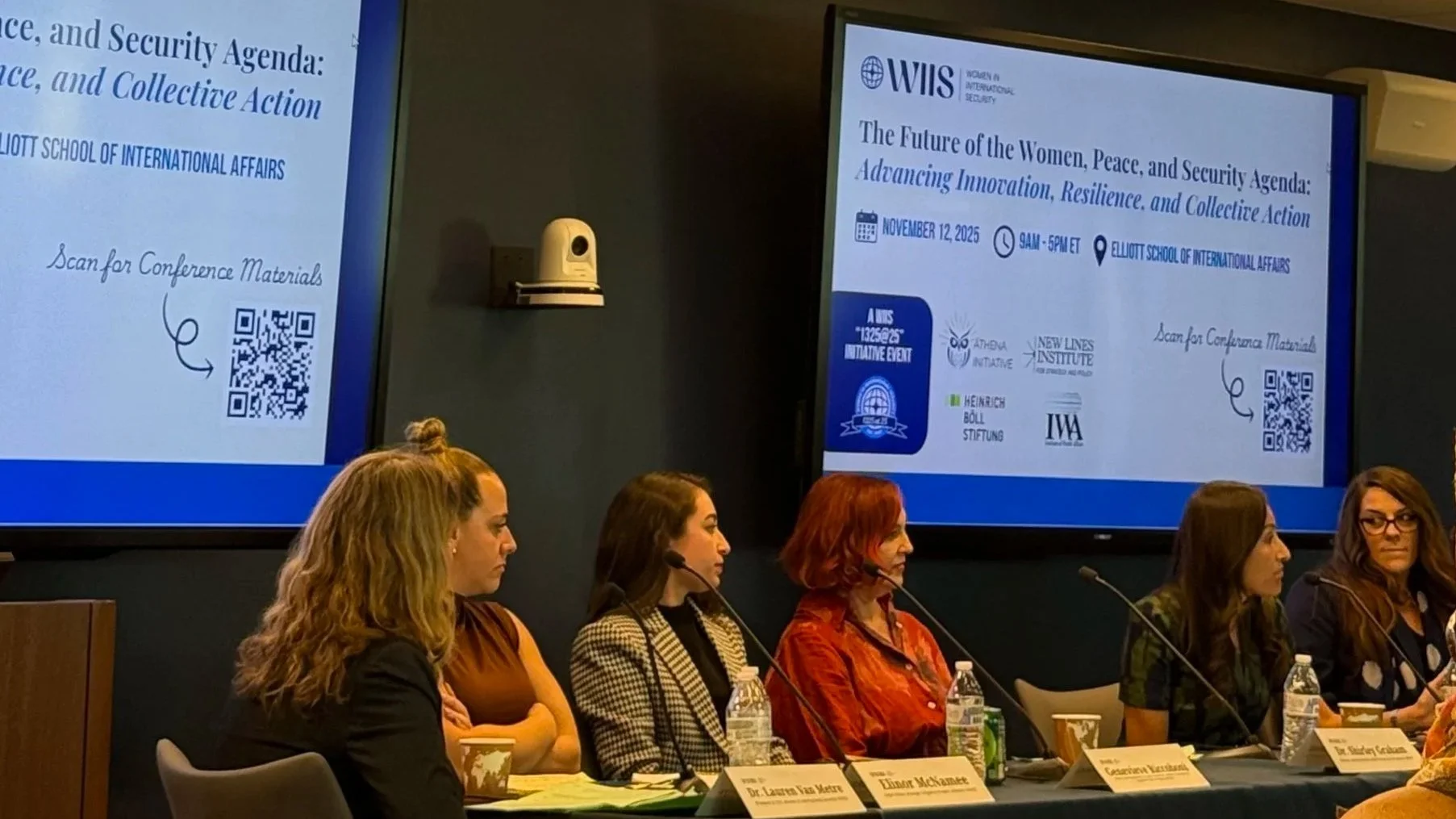
Moderator Lauren Van Metre (left) alongside the Panel III speakers.
Moderated by President & CEO of WIIS, Lauren Van Metre, the third and final panel brought experts from diverse backgrounds together to discuss the importance of WPS collective action in today’s political climate. Genevieve Riccoboni, Program Coordinator at the Women’s International League for Peace & Freedom, stated that WPS is an approach but also ideological, challenging who has the right to make decisions about peace and security. She emphasized that young people have the ability to unite multiple issues and hold those who have failed them accountable. Megan Corrado, Deputy Executive Director at Alliance for Peacebuilding, noted that the ‘S’ in WPS is the weakest link, as civil society focuses the least on this component. We should take on a “do no harm” approach to collective action to preserve the last bit of WPS in government. When asked how we can ensure WPS remains a priority of foreign policy and militarization debates, Tahina Montoya, former member of the U.S. Air Force and Defense Fellow at WIIS, stated “we cannot advance WPS as a framework without being within the military”. 1% of Americans serve in the military and in the air force, 17% are women. Less and less youth see themselves serving in the military. We must reframe what militarization means; it does not necessarily mean serving, but it could mean joining the Peace Corps.
Another main focus of the conversation was what we can do amidst enormous political pressure on universities, student movements, and gender studies programs. Dr. Shirley Graham, Director of the Athena Initiative at GWU, said organizations such as Alliance for Peacebuilding and Feminist Foreign Policy Collaborative are working towards keeping words such as “gender” and “gender-based violence” in scientific foundations. Finally, Elinor McNamee, legal fellow at Atlantic Council Strategic Litigation Project, discussed the importance of intergenerational solidarity in furthering the gender apartheid agenda. She said “if you are working in political spaces, gender apartheid should be on your radar and you should be talking about it.” When asked if there are any alternative spaces of collective action for WPS, she said “Forget the alternative spaces; the only space we have here in the United States is civil society.”
Overall, as a consortium, we believe the event was a major success. Conversations such as these are essential for advancing the systematic inclusion of WPS principles and encouraging their practice in our daily lives. The GW WPS Publications Team is committed to raising awareness of these principles and continuing to spread knowledge to foster a more inclusive and informed community.