
Roots of Change: Women, Agriculture, and Economic Development
By: Siya Goswami
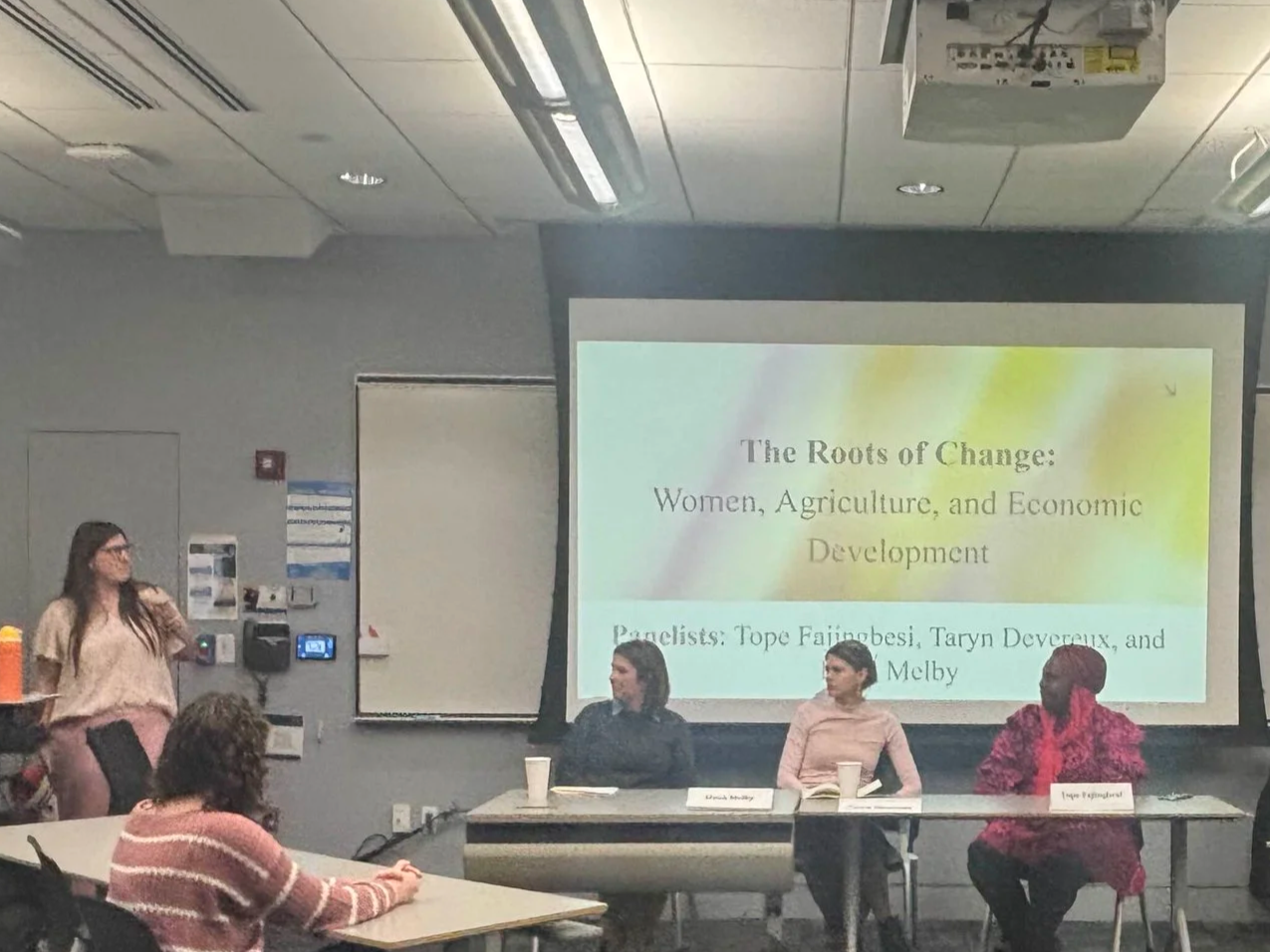
From left: Moderator Ava Van Nortwick, with the three panelists.
The George Washington University Women, Peace, and Security (WPS) Consortium hosted an event titled “Roots of Change: Women, Agriculture, and Economic Development," in partnership with the Global Food Institute on Wednesday, November 12.
The panel featured three speakers from various backgrounds:
Dana Melby: Piedmont Environment Council’s Gilbert’s Corner Farm and Land Manager
Taryn Devereux: Researcher, Educator, Strategist, Adjunct Professor at the Global Food Institute
Tope Fajingbesi: Social Impact Entrepreneur, Founder of She-E-O
The first question centered around the idea of how women are often central to agricultural production, yet remain concentrated in informal or unpaid sectors. The panelists were asked to offer their views on increasing women’s participation in the formal agricultural space, and how that could boost economic development and strengthen gender equality. Melby, who has spent much of her life and career in northern Virginia, spoke about the barriers she faced as a woman farmer. Melby noted that while only 5% of U.S. farmers were women in 1978, that number has grown to 41% today. She explained that this shift was evidence of women redefining what it means to be a farmer. Growing up in the Shenandoah Valley, she never viewed farming as a viable career path, in part because the image of a farmer was narrowly tied to white men with multigenerational ties to the land. She emphasized, however, that a farmer is “not the one driving a tractor all day.” Many women engage in care work, bookkeeping, weeding, and social media marketing, which she argued requires better quantification if women in the sector are to be elevated. She also highlighted persistent structural barriers, with land access being a central concern. Farmland continues to be passed down patrilineally, and women often are cut out of that inheritance. They are also less likely to receive funding from the government, as they are currently only accessing 17% of grants from the Natural Resources Conservation Service (NRCS). 84% of those grants directed to women are for white women, adding a layer of inequity.
Fajingbesi added that profitability remains a major obstacle, noting that many women lack the business training needed to scale agricultural operations. She described her own experience hosting policymakers from Howard County and the State of Maryland on her farm and observed that women-led farming often draws more interest from the public. However, this does not erase systemic challenges. Devereux echoed these concerns, explaining that many women do not see themselves as farmers even when they perform substantial farm management tasks. This lack of self-identification leads to gaps in pursuing resources relevant to their agricultural development, ultimately limiting their participation in formal agricultural systems. She stressed the importance of measuring and recognizing their labor, describing it as a core component of the “machine that churns our economy.”
The discussion turned to the role of women in sustainability and climate resilience. Fajingbesi remarked that women are often more receptive to behavior change around environmental practices, especially in light of climate change. She drew on the caregiving roles and concern for future generations that women tend to carry, andpointed to regenerative agricultural practices such as crop rotation and cover cropping as tools for not only protecting the land, but demonstrating the realities of climate change. Devereux observed that although these techniques have existed for centuries, many have been reframed as masculine and Western despite being rooted in Indigenous knowledge carried by women. Both she and Fajingbesi argued for stronger investment in women-led farming initiatives, noting that women are more likely to prioritize health and climate-smart decision-making. Melby also noted that it is critical to recognize that women are not a monolith and bring diverse perspectives to the table.
When asked about effective strategies for increasing women’s participation in agriculture and economic development, the panelists emphasized community-driven approaches. Melby drew on her own experience managing a community farm, stressing the urgent need for improved agricultural literacy in the United States. Devereux expanded upon this, highlighting the power of investing in local women leaders and community-based networks rather than relying on short-term foreign NGO interventions that are often temporary and isolated from local contexts. Fajingbesi called for more open conversations about the realities women face in agricultural spaces, including how issues such as menstruation and menopause can affect their work, yet are rarely acknowledged.
The event concluded with reflections on what gives each panelist hope for the future of women’s empowerment in agriculture. Melby spoke of her two daughters and the possibility that they may one day choose farming as their career, hoping they would be supported by stronger female leadership in the field. Devereux reflected upon the ingenuity of resilience of women who make the most of the limited resources available, and Fajingbesi shared her optimism recounting the story of a colleague’s daughter whose curiosity about nature symbolizes a promising future for women’s empowerment in agriculture.